

Boston College Professor, David Blustein is one of the leading scholars of vocational psychology in the world. In recent years his work has become increasingly interested in social justice, decent work and the role that vocational psychology and career guidance can play in helping people to advance their situation. In this post Raza Abbas interviews David about his work, career guidance and social justice.
You can follow David’s work on Twitter at @BlusteinDavid as well as on his University webpage.

RA: Can you share your insights on social justice in career guidance?
DB: My fundamental belief and value is that social justice is integral to our field. The process of considering one’s career plans, engaging in work, dealing with other people at work, managing relationships and power hierarchies at work, and finding purpose and meaning at work involves the interaction of people and their contexts.
The sad reality of our social and economic systems is that inequity has been and continues to be a major factor in our work lives. As such, the challenges of social justice are always evident. My view is that we need to engage in an honest and critically informed analysis of the complex barriers that exist in education and work in order to provide support for clients and to engage in research and policy advocacy that can change the world.
RA: What emerging trends do you think that researchers and practitioners in vocational psychology and career guidance should focus on?
DB: The emerging trends in a social justice-informed analysis of work and careers are particularly evident when we adopt a critically conscious perspective. I will summarise my thoughts below:
- I believe that it is essential to reflect on the larger systemic issues that serve to sustain oppressive and racist practices. It is not enough to simply identify these sources of marginalisation and inequity; we need to take a broader perspective to fully understand how social, political, and economic forces are established and how they are maintained.
- A related point is the need to identify the underlying role of racism, sexism, heterosexism, anti-immigration, classism, and other forms of marginalisation in social injustices. This process is not purely an academic task—it involves deep level of self-reflection to identify one’s own sources of marginalisation and privilege. Without this honest self-appraisal, I believe that the social justice endeavor can quickly become a virtue-signaling process that does not move the needle forward in an appreciable way.
- Transforming our societies into fair and equitable communities necessitates that we all assume shared responsibility and shared sacrifices. People often need to own and give up privilege as we sort out how to fairly distribute resources.
- I also believe that a much needed critique of capitalism is becoming a central part of the social justice agenda in our field. We have seen the limitations and abuses of capitalism for too long; I also think that the time is right for a serious analysis of how we would like to construct an economic system that is fair and that prioritises people over profits.
- In addition, I think that career guidance needs to embrace the important role of labor unions and other forms of workers’ organizations. The decline in unions over the past half a century is a major factor in the growth of precarious work and inequality.
RA: What role do you believe career guidance has in challenging inequality and promoting social justice?
DB: I believe that career guidance has a major role to play in challenging inequality and changing our society. Prior to elaborating, I do want to acknowledge that it is not always easy to consider these challenges when counselors are working with individuals and groups who have pressing needs that merit professional attention. That said, there are ways for counselors to engage in social justice while meeting the needs of their clients and their employers. I will briefly summarise some of my thoughts on how counselors can engage in promoting social justice below:
- Adopt a critically conscious view of one’s work as a counselor: Using critical consciousness (which has been described in psychology of working theory and in the recent work by Hooley, Sultana, and Thomsen) is a powerful lens that can enrich career guidance.
- Engage in activism and advocacy: As a profession, we can mobilise our field to take a more assertive role in changing the conditions of education, work, and society to support people as they seek to make their way in their career plans. This activism can be generated by career guidance professionals and by the students and workers who we seek to support.
- Conduct research that seeks to make changes. The research and theory that underlies the career guidance profession is increasingly tackling the sort of social justice issues that I have outlined in this interview and detailed in my contribution to our literature. I also strongly recommend recent articles by Ellen McWhirter and Ishbel McWha-Hermann and by Melanie Elyse Brewster and David Alejandro Lopez Molina. These two articles are game-changers in the social justice mission in our field; I urge readers to read and reflect on these contributions in depth.
RA: In your opinion when can social justice advocacy start and how can we as a community of researchers and practitioners interested in career optimise it’s outreach and impact?
DA: I believe that the social justice movement has been underway since our field started over a century ago. Of course, I acknowledge that the social justice initiatives in our field have generally not been prominent or part of the mainstream discourse. However, there have been progressive ideas in our field for many decades, focusing on enhancing opportunities for students and clients, affirming the importance of decent and dignified work, and in addressing long-standing problems of racism and sexism in education and work. During the civil rights movement in the U.S. and in the feminist movement globally, courageous scholars and activists in our field have worked hard to identify the sources of oppression and to chart a different vision for people as they navigated the often unwelcoming world of work. Some examples include critiques of interest assessment, identifying sexism and racism in career guidance practices, and expanding the scope of our mission.
Optimising the impact is also an ongoing process. The creation of this website and blog by Tristram Hooley and his colleagues is a great example of how to advance a social justice agenda. These articles are open access and allow practitioners and scholars to disseminate their ideas quickly to interested readers. Plus, an open access forum such as this one provides a way to expand our audience. Other efforts can include developing social justice-informed practice guidelines that counselors can use; identifying a progressive research agenda for our field; and collaborating with related professional groups that already practice from an explicit social justice agenda (such as social work).
RA: What do you think that some of the problems have been in career and vocational guidance in relation to social justice?
DB: I do believe that there are commercial interests and other influences in our field that may serve to constrain social justice-based initiatives in career guidance. A cursory glance at the professional landscape of our field quickly reveals that vested interests have taken root in our field, often with very positive intentions and products. However, the focus on expanding one’s market and serving stock holders may create conflicts that could impede the inclusive goals of social justice informed career guidance practices. Perhaps the best example is in the world of psychological assessment. Personally, I am not ideologically against the role of assessment in career guidance; however, assessments in general, particularly assessments of aptitude and cognitive skills, can easily serve to reinforce racial, gender, and social class hierarchies. Moreover, there may be easier and less costly ways to foster self-knowledge via creative career interventions.
Another problem in career guidance is the over-emphasis on individual agency as the prime factor in fostering growth and development. Of course, I am in favor of helping students and clients learn the skills to be able to navigate the world of work.
However, the danger of an over-emphasis on individual agency is that it neglects or minimizes the role of contextual factors, which play a major role in the work and career contexts. In addition, implicit in the focus on individuals as change agents is that it creates a belief that people are functioning in decontextualized environments. The process of career development necessarily is a relational act, as stated so eloquently by my colleague Hanoch Flum; as such, career guidance needs to embrace a holistic approach to practice, research, and public policy.
Finally, the job structure for many career guidance professionals does not often create space for advocacy, research, or activism. I am aware that institutions have productivity goals for our work; however, we need to make a case for providing time in the workday for community-based work that can change some of the more adverse aspects of the contexts that our clients and students face.
RA: What are you currently working on?
I am working on a number of projects that I will review here:
- Along with Lisa Flores, we are editing a book of essays about rebuilding work as an institution.
- My research team and I are conducting research on the role of racism in career guidance and in the workplace more broadly.
- We are also working on studies about precarity and the pandemic.
- In partnership with an international team of researchers, practitioners, and activists, we have developed psychoeducational group workshop content for unemployed and underemployed adults facing work-based transitions. Our intention is to disseminate this workshop content as widely as possible at no cost to agencies or providers. This project, known as the Work Interventions Network, is a multifaceted initiative that integrates program development with research and advocacy to support those who are struggling with work and to create knowledge that can help to change systems and institutions.
- I am currently working on projects related to workplace dignity with a focus on understanding its role in career development and connecting strivings for dignity to broader social justice aims.
- Most importantly, I am committed to leading a balanced life where I can spend quality time with my wife, our kids, and our grandchildren. A major social justice insight is that work is not everything and that a rewarding life is build around relationships and connections.
RA: In closing, can you enlighten us with your valuable thoughts on creating a meaningful and dignified life that promotes social justice and decent work?
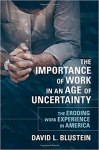
DB: I would like to close by basically endorsing the essence of this question. I believe that everyone has a right to a decent and dignified life that includes a meaningful career. To me, human rights necessitates workers’ rights. And, workers’ rights will require a critical perspective of our social, economic, and political institutions. I have outlined a social justice-informed public policy agenda in my recent book entitled The Importance of Work in an Age of Uncertainty: The Eroding Work Experience in America. In many ways, this book foreshadowed the intense precarity that has emerged during the pandemic. I think that activist and humane government and institutional interventions are needed to rebuild work that guarantees people a means for survival, social contribution and connection, and self-determination.
Thank you Raza and the rest of the team in producing this blog and creating this wonderful website.
 Critical Perspectives on Career and Career Guidance (COCAG)
This is such an important interview. David’s work is critical in shaping the future of career and vocational guidance research. We are very lucky that he is such a strong advocate of social justice.
LikeLike
[…] (3) Raza Abbas’s interview with David Blustein was also one of the most highly read pieces. ‘Everyone has a right to a decent and dignified life that includes a meaningful career’ – An i…. […]
LikeLike
[…] ecosystem and how supportive employers can help people flourish. There are widespread fears about the erosion of work for many people in society. However, in the research we gleaned insights into what Good Work looks like. We […]
LikeLike
[…] you figure out that dream role, you should try to look for what careers scholars such as David Blustein and Amartya Sen have described as decent and meaningful […]
LikeLike
[…] you figure out that dream role, you should try to look for what careers scholars such as David Blustein and Amartya Sen have described as decent and meaningful […]
LikeLike
[…] you figure out that dream role, you should try to look for what careers scholars such as David Blustein and Amartya Sen have described as decent and meaningful […]
LikeLike
[…] you figure out that dream role, you should try to look for what careers scholars such as David Blustein and Amartya Sen have described as decent and meaningful […]
LikeLike
[…] you figure out that dream role, you should try to look for what careers scholars such as David Blustein and Amartya Sen have described as decent and meaningful […]
LikeLike
[…] you figure out that dream role, you should try to look for what careers scholars such as David Blustein and Amartya Sen have described as decent and meaningful […]
LikeLike
[…] you figure out that dream role, you should try to look for what careers scholars such as David Blustein and Amartya Sen have described as decent and meaningful […]
LikeLike
[…] you figure out that dream role, you should try to look for what careers scholars such as David Blustein and Amartya Sen have described as decent and meaningful […]
LikeLike
[…] you figure out that dream role, you should try to look for what careers scholars such as David Blustein and Amartya Sen have described as decent and meaningful […]
LikeLike
[…] you figure out that dream role, you should try to look for what careers scholars such as David Blustein and Amartya Sen have described as decent and meaningful […]
LikeLike