
Thank you very much to my former colleague Tahira Majothi for writing this post. She is a careers consultant in Higher Education. This is the first of two posts she has written. In this first post she outlines the issues raised by Black Lives Matter and in the second post she will go on to make a call for action for the careers profession about these issues.
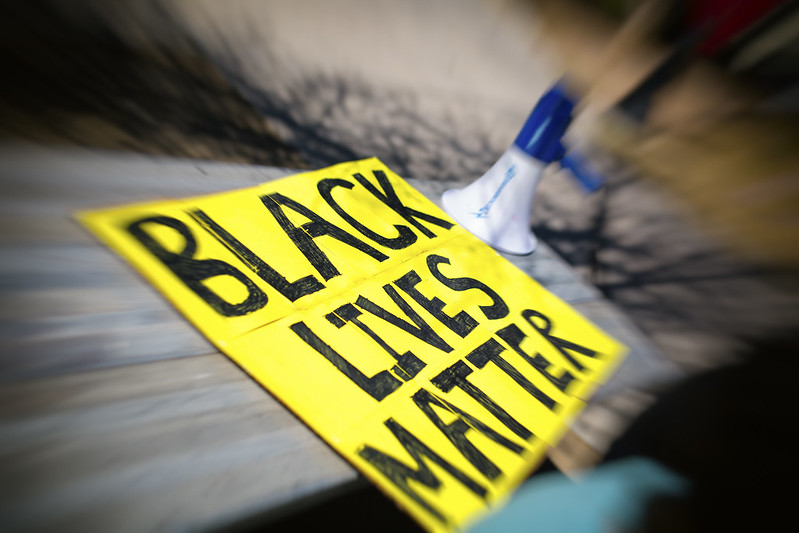
Johnny Silvercloud: CC Attribution-ShareAlike 2.0 Generic (CC BY-SA 2.0)

In May 2020, people the world over watched the moment a video captured the death of a Black man, George Floyd by a White Police Officer. The Officer pressed his knee down on Mr Floyd’s neck for nearly eight minutes, all the while staring defiantly at camera while Mr Floyd pleaded for his life, a heartbreakingly devastating sight.
For those of us able to recollect other notable instances of brutality and racial injustice among the many including Breonna Taylor, Rodney King or Stephen Lawrence, this was not a new or rare occurrence. Indeed to watch someone have such disregard for the sanctity of life of another human, to fail to see the humanity in a man so visibly suffering was hard to watch. Hard to comprehend but not shocking, or unfortunately surprising especially for Black communities across America and the world. Communities, used to seeing these occurrences on an all too regular basis, without always having technology to hand to record these instances.
The impact of the video rightfully made people join Black Lives Matter (BLM) activists’ in calls for action to tackle racial injustices and inequalities, all against the backdrop of a global pandemic, unique in recent history. A pandemic, which has significantly affected social interactions with family, friends, work, economies, politics and wider society. This pandemic has been unforgiving in staggering ways, but most acutely highlighted the stark health, social and economic inequalities, disproportionately affecting Black, Asian and Multi-Ethnic communities.
Naturally, we feel compelled to want to do something, to attend protests, share petitions, show our solidarity and check in with friends, family and colleagues to discuss these events.
What can we do as careers professionals to work towards tackling racial inequalities?
We can start by trying to understand the issues Black, Asian and Multi Ethnic communities face within education and employment.
I wish to preface this piece at this point, by stating that it is not my intention to erase nor minimise any one particular ethnic group’s culture or heritage. As a British Asian-Indian Muslim woman, I am aware that the words ‘Black, Asian or People of Colour’ can be problematic catch-all or umbrella terms, as they do not do justice to the nuances and differences in ethnicities, cultures and experiences of people from for example, Black British, Black African, Black Caribbean, Black Afro Caribbean or Dual Heritage backgrounds. Therefore, whilst not ideal, for the purpose of this piece I will be using the terms Black, Asian and Multi-Ethnic throughout.
Navigating unchartered waters – what is on the horizon for students and graduates?
As the new academic year approaches, the education and labour market landscapes have for the time being, changed. These affect our services and learners in numerous ways e.g. travel restrictions, lockdown and quarantine requirements, grade controversies, the availability of further or higher education places, reduced staff or resources, phased return to work, continued use of digital platforms, changing job opportunities, job security and recruitment. At the heart of our roles in student facing services, we work diligently to try to help students and graduates realise their aspirations. We do this, whilst being aware of the likely impact societal changes/policies will have on the university experience of our students, both new and returning, not least those from widening participation backgrounds. Indeed most institutions will have action plans already in place with objectives mapped against access and widening participation figures, with input from careers services.
Differences in employment prospects for Black, Asian and Multi Ethnic graduates
There are of course differences in access to opportunities, networks, life experiences and privileges across different ethnic groups, which can hinder social mobility. The Runneymede Trust’s report ‘Over-exposed and under-protected’ details the impact of Covid on Black and Minority Ethnic communities, including those more likely to be in key worker roles.
A report by the Fawcett Society highlighted pressures felt by BAME women during lockdown in relation to health, work and family.
Black, Asian and Multi Ethnic employees make up 12% of the UK labour work force but are more likely to be adversely affected by the fallout from the pandemic due to higher numbers working in sectors worst hit e.g. travel, accommodation and food services.
The Carnegie UK Trust’s report on ‘Race Inequality in the Workplace’ also highlighted inequalities facing Black, Asian and Multi Ethnic millennials. The report found, that even taking into consideration, factors such as gender, family backgrounds and education:
- BAME Millennials were 47% more likely to be on zero hours contracts.
- Were 5% more likely to be undertaking shift work and 4% less likely to have permanent contracts, in comparison to their white peers.
- There were also differences in employment prospects, by ethnic group. Those from Pakistani (9.1%), Black African (8.7%) and mixed-race backgrounds (8.2%) were more likely to be unemployed than those who were white (5.1%).
- Although Indian, Bangladeshi and Black Caribbean adults were no more likely to be out of work than their white peers.
The value of using labour market research to inform employer engagement strategies
It is time we used ethnicity and employment reports in a strategic manner to inform the way we work by better understanding the makeup of the labour market and our relationship with employers and key stakeholders, when sourcing and promoting opportunities.
A good start would be to audit our own internships, mentoring schemes and the employers we connect with, to find good development opportunities and fair or secure work conditions for all.
Whilst continuing to work with employers who proudly declare their commitment to diversity, concerted efforts should be made to reach employers who have traditionally had an underrepresentation of Black, Asian and Multi Ethnic employees. We can help students and graduates make professional connections and broaden horizons, whilst championing the positives of a diverse and dynamic workforce, to employers.
I know how important this is. I undertook work experience at my local paper because the editor gave a guest talk at School and mentioned he was disappointed there were no Black or Asian staff working for the paper. Being able to work in roles where people like me were not visible or considered the “norm” gave me insights into careers I would never have contemplated. Which was eye opening and hugely beneficial for me as someone who lived at home whilst studying at university, came from a working class lower socio economic background and lacked professional connections and career confidence.
Now, a few years down the line, its deflating to see that differences in graduate destinations for ethnic minorities have not greatly shifted in terms of parity of experiences for all graduates entering the labour market.
A report by the NUS and UUK – ‘Black, Asian and Minority Ethnic Student Attainment at UK Universities’ highlighted experiences of Black, Asian and Multi Ethnic students. Negative experiences can have longstanding life chance implications for students and their sense of self. This could lead to higher numbers dropping out or not even consider an academic career as an option.
The report also found differences in White students and Black, Asian or Minority Ethnic students obtaining a first- or upper-second-class degree was among the most stark – 13% among 2017–18 graduates.
“In terms of graduate destinations and employment, 62% of White graduates domiciled in the UK, were in full-time employment. This is 8 percentage points higher than UK domiciled graduates in BME groups. Graduates of Black, Asian or Other ethnicity were more likely to be unemployed than White graduates.” Similar gender and ethnicity gaps were noted in the new destination tracking survey ‘Graduate Outcomes’.
There are fewer Black, Asian and Multi Ethnic staff in senior academic and university leadership roles, of 19,000 people employed as professors in the UK, only 400 are BAME women. Do we have a similar diversity problem within Careers Services?
Understanding intersections of disadvantage
For many Black, Asian and Multi Ethnic people, not only do racial inequalities and injustices exist, at times, intersectional disadvantages come into play, presenting additional challenges. From being the first in the family to attend university, not necessarily having the connections or confidence to access support. To higher numbers of Black, Asian and Multi Ethnic students in widening participation categories such as being from lower socio economic backgrounds, carers, mature students, living at home, additional support needs or identify as LGBTQ+ to name a few. In addition, limited access to technology or space to work/study at home can compound matters.
Whilst these factors are not always indicative of negative experiences or underemployed graduate destinations, they can affect studies and prove to be lonely experiences if the correct support is not in place when needed.
Subsequently Black, Asian and Multi Ethnic students may have legitimate questions around aspirations and progression. For instance, if a Black, Asian and Multi Ethnic student received a lower than expected award, they may wonder how employers will view this? What about support for EU and international students who might identify as Black, Asian and/or Multi Ethnic? How can we provide meaningful employability-focused experiences, events, mentors, professional (international) networks etc? How can we support Black, Asian and Multi Ethnic students (Home, EU or International) who have faced racism?
What support is in place for Black, Asian and Multi Ethnic students adversely affected by Covid, including their own physical or mental health or that of loved ones and acquaintances?
Then there is the new way of working online and interacting via virtual platforms. Initial conversations with students indicate that whilst they are missing the University experience and their peers, they do feel more comfortable talking to employers online, as they feel listened to. Perhaps technology can help minimise biases or perhaps it further shines a light on them? It is too early to tell.
In my next post which will be published in a few days, I set out what we can do as Careers Professionals and Careers Services.
 Critical Perspectives on Career and Career Guidance (COCAG)
[…] Thank you to Tahira Majothi for writing this post. This is the second of two that she has written. Her first post was entitled – Black Lives Matter and the Careers Profession: Silence is not an Option […]
LikeLike
[…] Black Lives Matter and the careers profession – Silence is not an option. 2020 was as much the year of Black Lives Matter as it was of Covid. So, thank you to Tahira Majothi for this piece looking at how this issue has been addressed by careers services in UK higher education in this piece and a follow up post. […]
LikeLike