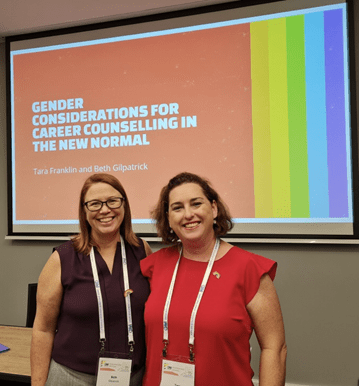
In this post, Tara Franklin (she/her) and Beth Gilpatrick (she/her), discuss career development strategies and action plans when assisting students of all genders.
We are Career Practitioners in Independent Secondary Schools in Brisbane Australia, currently both working in all-boys secondary schools, with extensive experience in single sex and co-educational settings. Last year at the Career Development Association of Australia (CDAA) National Careers Conference in Sydney, we collaborated on a presentation on gender social justice issues in career development titled “Gender Considerations for Career Counselling in the New Normal.”
Having had experience over a variety of settings, we both had noticed how our practice had small changes when working with students of a variety of genders and we felt that these differences needing exploring as students are more likely now to identify as either binary or non-binary. We examined the influences and obstacles for students making career decisions and how much gender was impacting these decisions. A list of explicit strategies and action plans were then developed to help guide practitioners when assisting students making career decisions.
Gender debate and its findings
Statistics show that in Australia there is significant growth in gender transition. The 2016 Australian Census:
- 5.4 people out of every 100,000 identified as a gender other than male or female
- 4.5% were in the 0-14 years category and 27.7 % were in the 15-24 years category, the ages that we work with the most in schools.
The recently published data from the 2021 Census shows a large growth in the number of people identifying as non-binary to 0.17% of the population. The impact of this growth still needs to be considered and researched.
Students are becoming more aware of their gender earlier on and they need to be supported not only emotionally through this journey but also through their career decision making process. Many transgender people are choosing their careers based on expectations and gendered norms and choose early on to eliminate many careers simply based on those that are safe or difficult to pursue. Xiberras argues that safer choices are those where people can express their identity such as the helping professions or the arts.
Those who identify with gender stereotypes are more likely to choose an occupation which they perceive matches this. Research shows that students who identify as more masculine or feminine still choose occupations that belong to that stereotype. The impact for career development is to be sensitive and inclusive of the individual who is seeking career advice (whether they identify as binary or non-binary) as even a student who identifies as male may feel as if he has feminine traits.
As careers advisors, we need to show no bias with the choices that students are making and encourage them to open their minds to future career options. We also need to encourage all students to look beyond stereotypes and consider options that will allow them to express their identity freely.
Influences, hinderances/obstacles
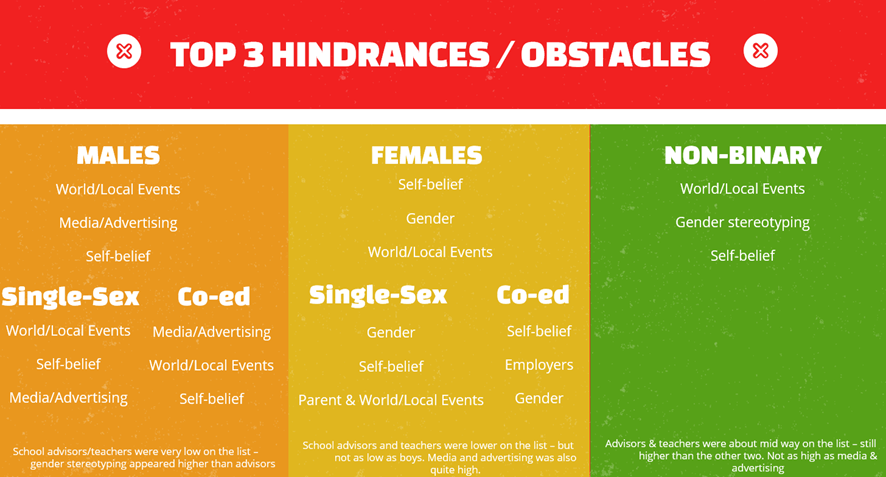
We conducted a study amongst several single sex and co-educational schools in Brisbane, Queensland Australia determining the top 3 influences on Career Decisions as well as the hinderances to career decision making:
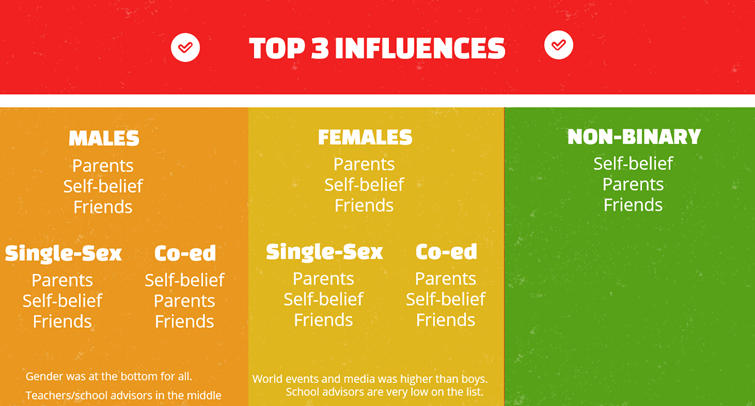
It is clear from this research that students who identified as both female and non-binary considered gender and gender stereotyping as an obstacle or hindrance when making career decisions. This was not apparent for students who identified as male. The positive career influences of parents, friends and self-belief however, are common amongst all students.
Strategies
Careers Practitioners are required to show compassion and understanding, LGBTIQA+ acknowledgment and respect and look beyond stereotypes and present options to be able to express their identity freely.
In particular, the following strategies were recommended:
- A more proactive approach to informing young people about work.
- Information, advice and guidance to young people should include details about the pay, the work-life balance and lifestyles associated with different kinds of jobs.
- Good quality work placements could play an important role.
- Parents / Guardians play a key role in the process of occupational choice and so they need to be provided with better information and support.
Final thought
We concluded our presentation with a reflection and a call to action to our fellow career experts…
What is the one thing you can introduce in your own practice?
We continue to research and advocate for greater diversity in Career Development and welcome anecdotes of best practice. Feel free to reach out via LinkedIn:
- Contact Tara Franklin
- Contact Beth Gilpatrick
 Critical Perspectives on Career and Career Guidance (COCAG)
Disappointing to see the title of this framed as a debate when the content is really interesting and thoughtful. Gender and the existence of trans and non-binary people is not a debate. If this were about other characterists, I suspect the word debate would not be used.
LikeLike