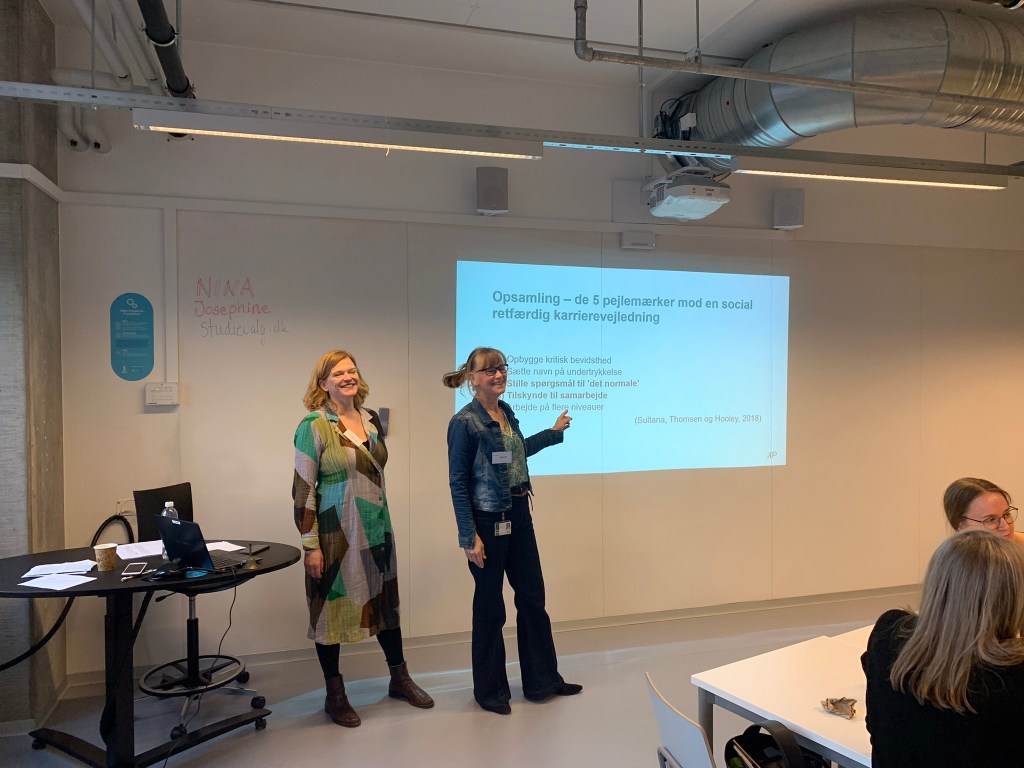
At a recent conference in Denmark, Charlotte Dahl, Andrea Hvid Hagn-Meincke and Rikke Ellegård Hansen presented on their approach to ‘collective guidance’. This post provides some insights into their work and offers some resources that other practitioners may be interested to use.
In the Study and Career Guidance service at University College Copenhagen, we are working with collective guidance to support students’ ‘sense of belonging’. Examples of exercises from our collective guidance activities were tested on guidance colleagues in a workshop at the Guidance Conference “National Career Guidance Day” in Copenhagen on 1 February 2023.
You can download our presentation slides at the end of the presentation in both English and Danish.
Using five signposts for critical emancipatory guidance

Our goal with the exercises in collective guidance is that our students, regardless of their different backgrounds and prerequisites, experience being seen and heard and being part of a community. We are inspired by a guidance definition by Ronald Sultana, Tristram Hooley and Rie Thomsen, which supports what they call ‘critical emancipatory guidance’. Guidance is defined by them as ’empowerment to struggle with the world as it is and imagine the world as it could be’ (Hooley et al., 2021).
The counsellor’s role is to support students’ awareness of structural conditions, i.e., “the world as it is”, and to co-identify opportunities for students to act in this world, both individually and collectively. This implies a focus on the world, which is in contrast to unilaterally focusing on psychological and individual causes and solutions to student challenges, where the study counsellor’s role is primarily to support the individual student’s self-reflection, often in individual guidance sessions.

In our development of exercises for collective guidance, we have challenged ourselves to use the five signposts for social justice in career guidance, which have been formulated by Hooley, Sultana and Thomsen (2021)and build on their suggestion for a definition of career guidance.
- Build critical consciousness
- Name oppression
- Question what is normal
- Encourage people to work together
- Work on a range of levels
As a starting point, we have been focusing on signposts 3 and 4 about “questioning the normal” and “encouraging people to work together”. However, it has turned out that the other signposts have also been in play, as all five tend to engage with each other. Below we describe how.
Exercise 1: “I vote with my feet”
In exercise 1, “I vote with my feet”, we primarily focus on “questioning the normal” (signpost 3).
Making the norm visible

We start by telling the participants that this exercise is about taking a closer look at the norm of what a “good” or “proper” student is. The supervisor presents a norm of “the proper student”, which most people can recognize. The “proper student” is of course social, good at group work, has control over his/her independent preparation, and can perform at exams and presentations in class. But who can live up to all that? Probably not many. By describing the norm out loud, we exhibit and caricature it in a way that slightly punctures it.
The “proper student” norm shows “the world as it is”. This is, among other things, the norm that the students are up against and must “struggle with” when they evaluate their efforts. By bringing it to light, we show how it works as a special performance logic, which may be linked to political interests. Here we aim in the direction of “building critical consciousness” (signpost 1).
Revealing that there are many ways in which being a student, can liberate students from tight and unrealistic norms. At the same time, the realization that you might have challenges in common with fellow students can dispel the notion that you are not normal when you cannot live up to the specific norm of the “proper student”.
Facilitation the exercise
After a short introduction, the participants are asked to stand on the floor, where three “rooms” are marked with tape. The supervisor now reads out three different statements, and the participants must “vote with their feet” by placing themselves in room 1, 2 or 3, depending on which statement match them best.
The counsellor reads: “As a student, I prefer to:
- Work alone and write the exam assignments alone. I have good concentration and thrive in independent work processes.
- Work in groups with several people. I learn best in collaborative relationships and love when good professional discussions drive projects forward.
- Work with one permanent study partner. It works well for me with a 2-person collaboration where we know each other’s strengths and weaknesses.”
The exercise continues with several groups of statements being read out, and the participants place themselves again in the different marked rooms, depending on what matches their preferences. The other statements are about:
- How do you work when you have a deadline
- How do you feel about presenting something in front of others
- Which types of collaborators do you value in a group
With this exercise, it becomes physically visible how the students are both similar to and different from others in their approach to studying. And because the exercise is facilitated by institutional authority, the differences become legitimate at the same time.
As a summary of the exercise, a dialogue is facilitated between the participants, where they talk to those they resemble as well as those they are different from. As counsellors, we hereby support the students in discovering each other’s challenges and strategies, both where they are different and where they are similar. Potentially, this can be an incentive to see new paths and together “imagine the world as it could be”. Here we “encourage working together” (signpost 3).
Among other things, we use this exercise in the workshop “Master Your Life as a Student”, which is an offer for students in the first semester of our various study programmes.
Exercise 2: “Turn-taking in speech”
“Turn-taking in speech” is also about facilitating dialogue about “the world and as it is and as it could be”. In the exercise, we encourage the participants to share:
- What has shaped their choice of education?
- Whether they have been educated in a different direction than their parents
- What they would like to change if they could change one thing about their education (in the workshop on the guidance day, we asked about work instead, as the participants were all counsellors and not students)
Instruction of the participants
The exercise is carried out by having the participants stand on the floor, where they are instructed through 4 steps for each question:
- The counsellor reads out a question, e.g. “What is one of the most significant experiences that have shaped your choice of education and profession?”
- The participants are given 1 minute to think about the question individually in silence.
- The participants are then asked to find a person among the other participants whom they do not know very well and stand face-to-face with that person. They take turns answering the question for 2 minutes each, while the other person is actively listening. The counsellor rings a bell when it is time to switch and when this part of the exercise is over.
- The counsellor reads out a new question and the participants find a new partner (see all questions in the attached slides)
The exercise continues until there are no more questions. Afterwards, the objective of the exercise can be tied up by discussing it either in smaller groups, in a plenary session or both.
To meet each other and become inspired
In this exercise, we point in the direction of “encouraging working together” (signpost 4), by letting the students meet each other. At the same time, we aim in the direction of “critical awareness” (signpost 1) by focusing on what has influenced the various students’ choices of education, including whether they have broken with family patterns or not. This can create attention to the fact that different students enter their education with quite different prerequisites and through various paths. Potentially, it can invite conversations about how social structures tend to be reproduced, but those patterns can also be broken, even if it is difficult (“naming oppression” – signpost 2).
Asking what the participants would like to change, opens up discovering new possibilities to act as an individual or group. Regardless of whether the question initiates actual initiatives or not, it can be liberating to experience the possibility to share ideas and “imagine the world as it could be” together.
Our role as counsellors here is to facilitate dialogue between the students so they can support each other, be inspired by each other, and possibly take initiative to act. It is possible to “work on a range of levels” (signpost 5) in this – individually, collectively and institutionally. The individual can be inspired to do something in a new way, networks of students can be established, or perhaps initiatives can be embarked on at an institutional level by student councils.
The exercise is well suited for a team, where the purpose is to get to know each other better and to get ideas for opportunities for joint action.
Looking more outwards – in individual guidance too?
Working with the five signposts has initiated reflections on the guidance form and the counsellor’s role. Collective guidance of students offers good opportunities to facilitate that the students “see” and “hear” each other, and potentially use their community as a starting point to discover new opportunities for action. Here there is ample opportunity to work further with developing exercises where we help the students to “look outward” for reasons for and solutions to their challenges.
But what about the individual form of guidance, which, after all, takes up a large part at educational institutions like ours?
The individual guidance room is typically a private room for the student, where we as counsellors help the student to look inward and discover individual strategies. We have become curious as to whether it is possible, also in individual guidance, to work with the signposts and thus also look more outwards towards the world. E.g., can we help the student direct his/her perspective towards fellow students and their common challenges? Can we work with questioning the normal and create increased awareness of the origins of norms? Can we encourage dialogue and cooperation on for instance study strategies? That could be interesting to investigate further.
Our workshop with good colleagues at the conference “Career Guidance Day” in Copenhagen and the feedback we received have certainly strengthened our interest in developing and testing different forms of guidance with the five signposts in mind. At the same time, it has increased our curiosity about how other supervisors work with these signposts. This, also, is an example of how sharing with others, whether colleagues or fellow students, can motivate action.
References
Thomsen, R., Hooley, T., & Sultana, R. (2022). Social retfærdighed og karrierevejledning: 5 pejlemærker for en kritisk emancipatorisk tilgang. I R. Buhl, & P. Plant (eds.), Karrierevejledning og bæredygtighed [Career guidance and sustainability] (p. 55-70). Frydenlund Academic.
Hooley, T., Sultana, R., & Thomsen, R. (2021). Five signposts to a socially just approach to career guidance. National Institute for Career Education and Counselling. Journal, 47(1), 59-66. https://doi.org/10.20856/jnicec.4709
 Critical Perspectives on Career and Career Guidance (COCAG)
~This is really interesting (and practical!) content. I work with adults on a part time leadership masters and I think these exercises could form a very useful part of our induction activities. Thank you for sharing the activities and materials.
LikeLike