Khaula Rizwan is an an educational consultant, social transformation leader and disability advocate. She believes that students with disabilities and from disadvantaged backgrounds have as much willpower and talent to pursue higher education opportunities as those with privileges and provides mentoring related to disability, higher education, and international scholarships. She currently consults with corporates, non-profits, and universities for more inclusive communication during the hiring, testing and admission process for students and graduates with disabilities. In this post she tells the story of how she became engaged in career development and social justice work.

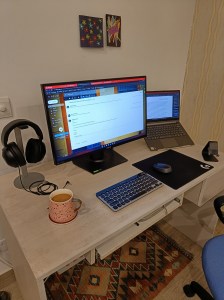
In March 2020, I decided to hand over my resignation as a product manager at a multinational telecommunication company. While everyone struggled to find a good conference tool provided to us by our company, there were no Zoom or Teams in the beginning of WFH. With intense code-switching between English and Urdu, I struggled with grasping communications which became even more inaccessible than board meetings in person. On top of these initial WFH challenges, no captions, or transcripts failed to compensate for the switch between the languages, since the conference tool is built in for audio in English only. As a hard-of-hearing professional, I felt excluded and found myself back in the zone of social inequality. My team tried to accommodate through random meeting minutes, but the inconsistent access to spoken communication was uneasy.
The same technology that enabled others alienated me as a hard-of-hearing person. This realization was, strangely, my silver lining amidst a pandemic that seemingly lacked one.
Fast forward one year later, I started my research as a career consultant in the global South and as a selection committee member for various international exchanges in the US and Europe. Using social justice and inclusion as a lens, I expanded my consulting portfolio to help students identify their strengths when choosing the best programs, and career pathways where they are more likely to succeed.
However, this change didn’t happen overnight; two major factors propelled it. Firstly, I like to see this as my Fulbright experience in play. My time in the US taught me advocacy and inclusivity, which I brought back home with me. I realized that timely and rightful access to technology was not just a hollow demand anymore – it was a basic human right; I had to stand up for students with disabilities who found themselves in the same position I was in March 2020.
Secondly, was the time I spent offering consultancy services pro-bono 4 years before the pandemic. This also allowed me to take that leap of faith with a plan in hand. I was also aware of the challenges and demands of being an inclusive career consultant and an international grad school advisor in Pakistan. Data-driven career guidance is still a nascent idea in the global South when coupled with concepts like social justice and inclusion – I was a little unsure about its reception in my community. But because of my 4-year consultation experience, I knew where I had to pivot – the “how’s” and “why’s” came together themselves.
Tabula Rasa
As a hard-of-hearing consultant, I networked extensively with other professionals and consultants with disabilities. I curated insights to make sense of the pandemic and sudden inaccessibility. Soon enough, managers and mid-career professionals began seeking career guidance from me; all of them troubled by the pandemic in one way or another. Discussions began to evolve around facilitating access, ensuring accessibility in the workplace, and the still-foreign concept of ableism. I networked on LinkedIn, created nurturing hubs and tribes, and a Facebook community space for co-mentoring aspiring scholars as a solopreneur. A year after I kickstarted my socially conscious consultancy, I was accepted to a 4-week long professional development program, Accelerating Social Transformation (AST) at the Evans School of Public Policy, University of Washington with a tuition waiver. The program helped me in a cohort of 45 social transformation leaders to envision a roadmap and catalyze a leadership mindset.
The reflection for my purpose-driven mindset was primarily “Why should students avail the services of an ‘inclusive’ counselor or consultant?” I recrafted my purpose statement and redefined my ‘Why’ to lead better counseling sessions.
Why?
My ‘why’ as an inclusive career consultant is to get students to integrate social justice and inclusivity into whichever career they choose for themselves. They should be able to think about how through their career, they can contribute meaningfully to their communities whether as a designer, an analyst, or a public health practitioner. In my experience, both as a professional and as a hard-of-hearing elementary student, mainstream educational setups seldom focus on things outside of the set curricula. The focus is on completing the syllabus and then testing the ‘learning’. Who is asking questions on how to tackle inequality? How do students truly acknowledge what makes them uncomfortable?
Luckily, graduate school applications and statements of purpose are excellent opportunities to project our unique selves, but it can be an overwhelming experience for even the most put-together student. I coach sessions from a lens of social justice and inclusion, getting students to raise critical issues at the intersections of race, disability and sexuality, and thus challenge the status quo.
How?
When the pandemic sent us to virtual rooms, I created my own space on inclusive terms to replace what were once in-person coaching and training sessions. I offer 1:1 virtual open-ended inquiry-based sessions. My pandemic sessions were spent experimenting with different technology, its positioning, and conferencing tools. Initially, I was asked not to disclose my hearing loss by well-wishers. I considered this preposition until my niece reminded me to offer my authentic self to my student clients. I decided to accept and offer my vulnerability to my clients. I wanted them to see me just as I was, shining light on their best parts through their university applications and statements of purpose. I envisioned a purpose – helping others find their “Why’s”.
The only way I am creating space for meaningful, thoughtful exchange is when students challenge their own “comfort” bubbles and acknowledge that I am probably the first hard-of-hearing professional they are interacting with. A client once said, “I spent so long oblivious to my privilege and casual ableism. It was our interaction that opened my eyes to the struggle of disabled persons in our society. Now, I can’t help but approach every situation with a lens of accessibility or lack thereof; whether it is eating at a restaurant that doesn’t have a ramp or watching a movie at a cinema that has no captions.” Inevitably, those who benefit from my inclusive career guidance do get into dream programs of their choice but often with a recurring thought: they need to work with their communities and champion social justice through their academic and professional trajectories.
Being an inclusive career consultant in a South-Asian society is a trial of its own. So is highlighting the student’s preconceived notions about topics like ableism and challenging their perception of me as a hard-of-hearing professional. One of my biggest motivations is seeing the lack of affordable options for students in terms of counseling, which killed more dreams due to applicants’ contradicting aspirations. The global South, specifically Pakistan, needs career counselors who understand the social justice challenges students face in their community and become informed counselees.
 Critical Perspectives on Career and Career Guidance (COCAG)