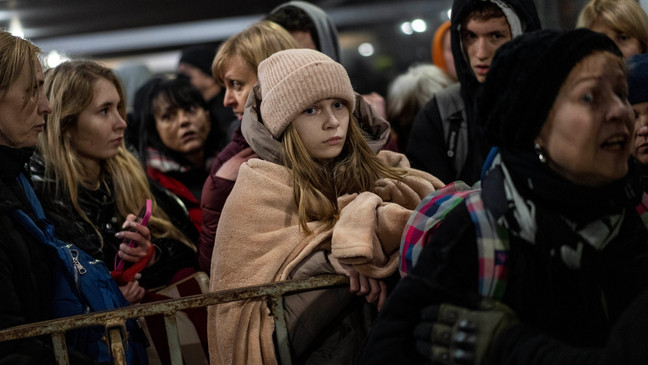
In response to our recent article on the situation in the Ukraine we are grateful to have a new article from Cristina Santos who is researching career guidance at the University of Cambridge. In this article Cristina explores the challenges that young refugees and migrants face as they seek to develop their careers and considers how career education and guidance might respond to this. We would love to feature more articles on this issue or on other issues related to the current crisis in the Ukraine, so please contact us if you are interested.

Think of a day when you were in a new situation. It can be, for instance, the first day of school, or that birthday party where you knew no one, a first go at a new hobby. Now, try and remember the feelings
you had that day. Those feeling are most likely memorable because they come from a situation when the survival-control centres of your body were activated.
You were either doing your best to fit (fight) or to avoid discomfort (flight). The spectrum of metabolic and behavioural changes associated with fight or flight responses is as wide as the intensity of the situation or stimuli that cause them. Nevertheless, the fact you remember that day can alert you to the potential impact that a situation where you flee or experience displacement can have on you in order to survive, be it because of war or not.
Most likely, if an individual needs to keep a high level of alertness and survival response for longer, the impact of such personal and contextual displacement may have deeper and longer-term repercussions. Concretely, these repercussions, may be grouped into three types: biological, social and psychological. Each may alter and help define the developmental outcomes for such individual.
Biological
In the biological sphere, the anxiety that comes from intense events such as fleeing, and displacement, may become a familiar state in the long run and affect how we think and relate with opportunities and people. In a moment of stress, our regulatory centre in the brain induces a cascade of neuronal and hormonal events that increase alertness and reduce the time we take to respond. While that is useful in one moment or another in our lives, it may be damaging to our well-being and disposition if too frequent and intense.
Take the example of post-traumatic stress disorder (PTSD). Anxiety episodes and other responses can have different unrelated triggers in the lives of those who experienced
intense and testing situations. Notwithstanding the biological response, if having had to question our safety, our belonging, our acceptance of others and our future opportunities, then our overall behaviour may become more defensive and anxious. The feeling of stability in various aspects of our lives, can compensate for the feeling of vulnerability when taking risks in other aspects of our lives. That balance will most probably contribute to a sense of higher self-confidence and of entitlement to the outcomes of such risks.
The difference here is neurological also, as anxiety impairs creativity and self-efficacy. If we are anxious, our thinking narrows to be fixated on what is normally more associated with safer, short-term gains. Creative thinking, on the other hand, allows us to imagine. Imagination is key to acquire and consider different perspectives, and to evaluate different possibilities. Being able to imagine when receiving career guidance is being able to form one’s own career narrative. The thinking and reflection involved in forming such narrative often needs the use of imagination as, for instance, in the linking between personal and situational characteristics and future possibilities.
Social
Equally crucial to the forming of a narrative, is being able to acquire new learnings of oneself in the face of the demands and opportunities of the world of work. This learning is often done through exploratory activities like listening to people talking about a certain career path or learning application, or work context immersion experiences, or, indeed, interview workshops or application letter workshops. Whichever the inputs to inform the narrative building of a young person, factors that impair reflection and positive disposition must first be identified to be counteracted, with appropriate and continuous support.
One other factor which may amplify the funnelling effect of anxiety, on career reflection and
exploration for instance, is social capital. A refugee, or otherwise displaced person, has had to leave home behind. If home is understood to be comprised of a sense of security, and of belonging, as well as the social grounds of one’s identity, then the displaced person has had to suffer significant damage to, if not total loss of, these inherent well-being factors. Much of the effort, after guaranteeing basic survival conditions, will most likely go to rebuilding a home. Furthermore, in a new context, the individual will need to forge new relationships with the new community, culture, and society. Note, however, that the refugee’s reformulations of home and social insertion are done, most likely, in an anxious capacity and without enduring specialist support. In the case of the displaced person, social capital will certainly be reduced. That person’s network in the new context may not be as influential as it was in the home context. And we all know how our contacts play a big part in our opportunities.
Thus, depending on the place of arrival and on the nature of social mobility in that context, the
displaced person would have to work harder to reduce their disadvantage and thereby gain the same opportunities as others. For instance, they may feel the need to establish a social network from scratch, and to relearn how to operate in the world of work of the place they arrive in. This is only likely to happen, however, if the displaced person is aware of the dynamics of career navigation wherever they are.
Psychological
Let’s now go to a situation in your life where you felt alienated, refused, even diminished. I, being a Portuguese teacher of science in the UK have had many. Repeatedly being considered ‘outside of the group’ has had a lasting effect on how attainable I find opportunities, as opposed to those who ‘belong’ more. Unfortunately, if we are not equipped with mechanisms to counteract the effects of alienation, and if we don’t utilise these mechanisms conscientiously, those effects might impact our sense of self-efficacy and achievement. We might have them lowering our self-esteem.
I remember this one episode when, in a school leadership meeting, a senior leader asked whoever was speaking to slow down as I might not understand. Events of this nature can be very subtle and can happen repeatedly, too. All that is needed is that you arrive in a different context and have to persevere in it.
Can you remember any experience of alienation or of feelings of not belonging? How did that shake your sense of self-belief? Was there a point when you asked yourself if you would ever be considered for your full potential, your skills, your values, rather than filtered for your differences?
Now imagine it for a refugee who has to make do in, most often, an intensely different context, at the same time as having to rebuild a sense of security. How will they be considered in the different social groups they encounter? Will there be stigma? Will they be made feel they will have to fight harder to ever get the same opportunities? Now think of that refugee being a student, in school, with many physical, cultural and social differences. That young person, who is making sense of themselves as well as of the world, may have to reformulate their notions of many things. That uneasy process may have to be accompanied by experiences of being made feel that their differences to others are hindrances to reach the same opportunities or success.
Fortunately, in schools we are increasingly cultivating school policy and practice that support all students, both pastorally and academically, so that all can thrive in as equal conditions as can be made possible. Yet, we might not be conscious enough of how we can help mitigate the long-lasting psychological effects of arrival in a different context, in a fragile body and mind. We still need to do work in that regard in the realm of career guidance.
Reflections for career guidance
If career guidance is seen as a ‘treatment’, rather than a ‘preventative’, practice, it may not be
equipping our students to the extent we wish. If, at any particular moment, students are supported with regards to their situational and personal characteristics, then we are not maximising their opportunities to really know how to know themselves and to build a career narrative from the career exploration they do. If two students receiving career guidance arrive with different experiences, contextual influences, and personal dispositions, they will most likely engage differently with it. If those differences are more extreme, the student who stands out for being in more fragile social, psychological, and biological circumstances will likely perceive a even bigger set back from comparing the likely chances of others with theirs. Think of career development as the distance on a running track. Imagine two students in starting lines differently distanced from the finish line. Think of the student at the more distanced start line as the displaced person, with bigger setbacks. If both have the same body and environmental conditions to perform as well in the run, they’ll both run a similar distance. But the student who started behind won’t be as likely to reach the finish line. Career guidance has, thus, the duty to bring everyone to the same start line before it expects that all can accomplish the same if given the same ‘treatment’.
In practical terms, educational institutions have a privileged place in the lives of young people to play the crucial role of scaffolding students’ vocational (career direction) preparedness. Teachers, career counsellors, form tutors, pastoral leaders are just some of the practitioners who can get to know the student very well. As spaces where relationships can powerfully inform practice, schools can moderate the informed liaison between the key agents in career guidance. The result can be that all students, no matter what the circumstances, and personal dispositions and characteristics, can have equal opportunities to form a career narrative and gain from it. In essence, we need to shift our thinking in career guidance planning and provision from ‘What works’ to ‘How can it work for every one’.
 Critical Perspectives on Career and Career Guidance (COCAG)
[…] Christina Santos wrote a very important piece on career guidance for displaced young people. […]
LikeLike