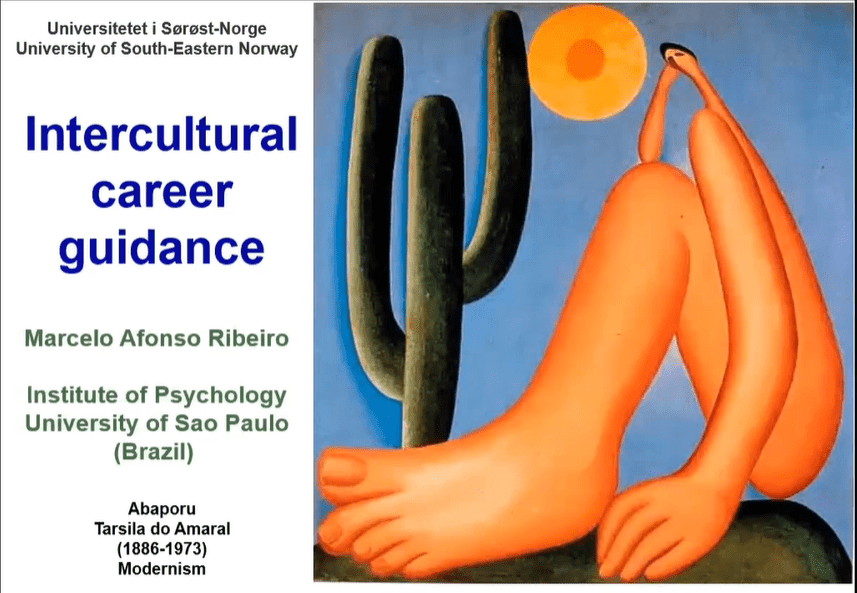
Sanna Toiviainen of the University of South-Eastern Norway discusses a recent seminar given by Marcelo Afonso Ribeiro on intercultural career guidance.

In September 2021 the Master Programme for Career Guidance in Norway (USN and INN) hosted a webinar where Professor Marcelo Afonso Ribeiro from the University of Sao Paulo, Brazil, presented on the topic on intercultural career guidance. Providing case examples and drawing on a wide scope of theories both from the “Global South” and “Global North” Ribeiro demonstrated how intercultural dialogue can be integrated to both career guidance theory and guidance practice.
In the first half of the seminar Ribeiro discussed the foundations of intercultural career guidance while the second half focused more on practical strategies and case examples. The grounding principles of intercultural career guidance were introduced through a variety of interesting concepts that draw widely on vocational psychology, social psychology, sociology, narrative theory, actor-network theory and feminist theory, to name but a few.
Intercultural career guidance is based on a relational ontology with the core understanding of the self as a psychosocial construct. Moreover principles of intercultural dialogue were discussed as well as how Latour´s ideas of hybridism can be introduced to understand how people construct their working identities. The emancipatory agenda of intercultural career guidance became clear as Ribeiro argued how principles of critical consciousness, understanding of intersectionality and respect for situated knowledges must and can be integrated soundly into guidance practice.

Practical strategies of intercultural career guidance were presented, emphasizing guidance as a process of co-construction which is based on a principle of diatopical hermeneutics, a concept referring to Boaventura de Sousa Santos. It can be defined as a process of interpretation (hermeneutics) carried out between persons or groups in different and unequal sociocultural positions (di – two and topoi – positions ) or knowledge production places. Other practical strategies introduced included discursive validation and critical consciousness construction.
What also was presented as a relevant resource in career guidance is the use of communitarian approaches where the role of career counsellor is to act more as a mediator and facilitator. Career counsellors can design interventions that are more embedded in the community. Here the task of counsellor is more to facilitate possibilities for people sharing similar social and cultural backgrounds to come together and share knowledge and experiences which are relevant for their unique context- and community-specific situations.
One of the key arguments for intercultural career guidance is that we need to recognize the incompleteness of theory and concepts. We need to be cautions of the productive power of career theory and models out there. These have the power to construct value-laden ´truths´ and ideologies about working, careers, career development, identities, or agency – while potentially silencing alternative understandings that can only be grasped through the lived experiences of people.
Intercultural career guidance is about acknowledging that counsellor and counsellee together, as equals, construct knowledge from their differing social and cultural positions. Central in interculturality is embracing knowledge always as incomplete. Important aspect is to think, how should we change guidance practices in order to ensure that counsellees´ knowledge is legitimated and validated. This is where communitarian strategies come in as uselful. They can ´damp´ down the institutionalised truths of global career theory and models and turn more towards the social and cultural knowledge embedded in communities.
Through using emancipatory approaches, intercultural career guidance also seeks to help people to find ways out from difficult and unsatisfying life circumstances that are maintained by broader and historical systems oppression. Through means of conscientization oppression can be made more visible and this can create altered and liberating views on one´s circumstances, which, in turn, can foster more decent working trajectories.
Access the video of the whole seminar (approx. 2.5 hours)
Basic references for the seminar
Ribeiro, M. A. (2018). Towards diversified ways to promote decent working trajectories: A life and career design proposal for informal workers. In V. Cohen-Scali, J. Pouyaud, M. Podgórny, V. Drabik-Podgórna, G. Aisenson, J.-L. Bernaud, I. Abdou Moumoula, & J. Guichard (Eds.), Interventions in career design and education: Transformation for sustainable development and decent work (pp. 180-201). New York, NY: Springer.
Ribeiro, M. A. (2020). Integrating discursive validation in career counselling: an emancipatory strategy to foster decent working trajectories and social justice. British Journal of Guidance & Counselling, 1-13.
Ribeiro, M. A., & Almeida, M. C. C. G. (2019). A socio-constructionist career counselling model grounded in the intersectionality of gender, class and race/ethnicity. In J. G. Maree (ed.), Handbook of innovative career counselling (pp. 597-613). New York, NY: Springer.
Ribeiro, M. A., & Fonçatti, G. O. S. (2017). The gap between theory and reality as a generator of social injustice. In T. Hooley, R. G. Sultana, & R. Thomsen (Eds.), Career guidance for social justice: Contesting neoliberalism (pp. 193-208). Abingdon: Routledge.
Silva, F. F., Paiva, V., & Ribeiro, M. A. (2016). Career construction and reduction of psychosocial vulnerability: Intercultural career guidance based on Southern epistemologies. Journal of the National Institute for Career Education and Counselling, 36, 46-53.
References – Theoretical background
Arulmani, G. (2014). Career guidance and livelihood planning. Indian Journal of Career and Livelihood Planning, 3, 9-11.
Berry, J. W. (2013). Achieving a global psychology. Canadian Psychology, 54(1), 55-61.
Duffy, R. D., Blustein, D. L., Diemer, M. A., & Autin, K. L. (2016). The Psychology of Working Theory. Journal of Counseling Psychology, 63(2), 127-148.
Gergen, K. J. (1991). The saturated self. New York, NY: Basic Books.
Guichard, J. (2016). Life- and working-design interventions for constructing a sustainable human(e) world. Journal of Counsellogy, 7, 305-331.
Hooley, T., & Sultana, R. G. (2016). Career guidance for social justice. Journal of the National Institute for Career Education and Counseling, 36, 2-11.
Freire, P. (1970). Pedagogy of the oppressed. New York, NY: Continuum.
Latour, B. (1993). We have never been modern. Cambridge, MA: Harvard.
McNamee, S. (2012). From social construction to relational construction: Practices from the edge. Psychological Studies, 57(2), 150-156.
Martín-Baró, I. (1994). Writings for a liberation psychology. Cambridge, MA: Harvard.
Ribeiro, M. A. (2017). Reflecting upon reality in a psychosocial manner: Social constructionist challenges for the fields of Career Guidance and Counseling (CGC) and Work and Organizational Psychology (WOP). In A. M. Columbus (ed.), Advances in psychology research. Volume 132 (pp. 113-143). New York, NY: Nova.
Santos, B. S. (2014). Epistemologies of the south. Boulder, CO: Paradigm.
Sultana, R. (2018). Responding to diversity: Lessons for career guidance from the global South. Indian Journal of Career and Livelihood Planning, 7(1), 48-51.
Complementary references
Blustein, D. L., Kenny, M. E., Autin, K., & Duffy, R. (2019). The psychology of working in practice: A theory of change for a new era. Career Development Quarterly, 67(3), 236-254.
Hooley, T., Sultana, R. G., & Thomsen, R. (Eds.). (2017). Career guidance for social justice: Contesting neoliberalism. Routledge.
Hooley, T., Sultana, R. G., & Thomsen, R. (Eds.). (2019). Career guidance for emancipation: Reclaiming justice for the multitude. Routledge.
Ribeiro, M. A. (2020). Career development theories from the global South. In P. J. Robertson, T. Hooley, & P. McCash (eds.), The Oxford Handbook of Career Development (pp. 1-16). Oxford, UK: Oxford University Press.
Ribeiro M. A., Silva, F. F., & Figueiredo, P. M. (2016). Discussing the notion of decent work: Senses of working for a group of Brazilian workers without college education. Frontiers in Psychology, 7, article 207.
Ribeiro, M. A., Cardoso, P., Duarte, M. E., Machado, B., Figueiredo, P. M., & Fonçatti, G. O. S. (2020). Perception of decent work and the future among low educated youths in Brazil and Portugal. Emerging Adulthood, Article 216769682092593.
Thomsen, R. (2012). Guidance in communities – A way forward? Journal of the National Institute for Career Education and Counselling, 28(1), 39-45.
Thomsen, R. (2017). Career guidance in communities: A model for reflexive practice. International Centre for Guidance Studies, University of Derby.
Winslade J. (2005). Utilising discursive positioning in counseling. British Journal for Guidance and Counselling, 33(3), 351-364.
 Critical Perspectives on Career and Career Guidance (COCAG)