
In this post Yelda Devlet and Tommaso De Cataldo from the International Organisation for Migration discuss the work that they have been doing supporting the employment of refugees in Turkey.

We are currently living in an era of unprecedented human mobility, where one billion people live in a different community from the one they were born. In this era of increasing mobility, it is critical that governments foster international cooperation and design appropriate policies and programmes to facilitate labour mobility that responds to labour market needs and economic opportunities. Such policies should both to protect international migrants and harness the benefits of migration for societies.
Turkey is no exception to these global trends and has become internationally known as the world’s largest refugee host country, with an estimated 4 million refugees (including 3.6 million Syrians under Temporary Protection, SuTP), The Turkish Government has made significant, forward-looking changes to its immigration policies and programmes over the past few years in order to better govern international labour flows, protect migrant workers, and position Turkey to better reap the benefits of international labour migration.
Employment support for migrants in Turkey

In an effort to generate employment through, a pre-employment support programme for SuTPs and host community jobseekers, IOM partnered with the Directorate General of International Labour Force (DGILF), the Turkish Employment Agency (İŞKUR) and the Vocational Qualifications Authority (VQA) in 2018. The specific objective of the programme was to promote the labour market integration of Turkish and Syrian beneficiaries by encouraging closer relations with the companies owners or representatives. The programme also aimed at enhancing the basic knowledge and skills that support the employability of job seekers to make the process of adaptation to the labour market easier for both target groups.
The programme is implemented in consultation and partnership with the mentioned key stakeholders as well as private sector partners and is perceived as an important tool for social integration, thus social justice for all.
About the programme
Our programme was designed to make the process of adaptation to the labour market easier for Syrians and host community members. The programme aims at enhancing basic knowledge and skills which support the employability of job seekers. It aims to support the job seekers of the two target groups to acquire the basic knowledge/information and, to a certain level, skills that could facilitate their work-based learning.
This process, in which employers and job seekers take part together, is a 5 day-programme. It aims for the employer and the job seekers to gain a better understand of each other and their needs. Moreover, it facilitates the job seekers to get to know their workplaces better and support the adaptation to work and social life. Work-shadowing was a crucial part of the programme and helped the jobseekers to see the work place/the company they want to work, to get involved in the work environment to learn about the job.
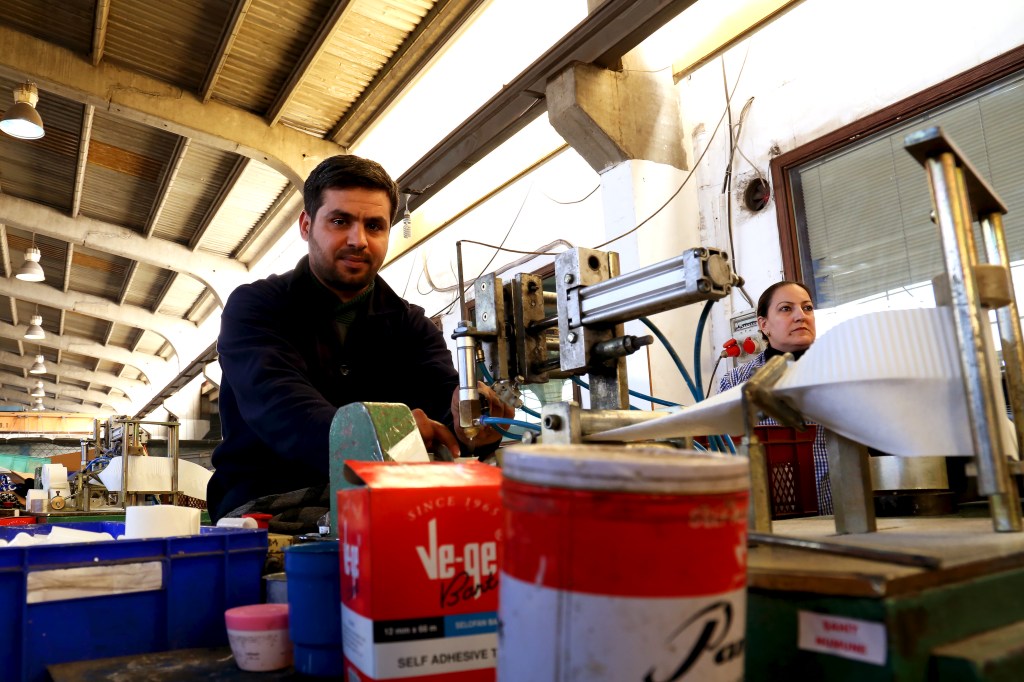
After the orientation programme, the beneficiaries started a 4-month on-the-job training programme where they were also provided with monthly salaries. The programme has been designed to strengthen the skills and qualifications of foreign and national job seekers by supporting their employment in specific sectors in Turkey that have labour absorption capacity. To date, the programme has supported the placement of 102 jobseekers, (51 SuTPs and 51 host community members) in the Turkish textile and packaging industries in three different cities in Turkey.
The voices of participants
“To take my biases away and to think more positively”
“To live and work together in harmony with the Syrian friends”
“What to do when we search for a job”
“Learned about our rights in work life”
“Developed self-confidence and a more optimistic look to the future”
“Integration is accepting the host country without losing our own values and traditions. We need to love the host country and develop belongingness”.
The active participation of the participants during the programme encouraged them to “listen”, “hear” and learn from each other. Moreover, the active participation of the related stakeholders in the programme as an introductory session was very informative and contributed to the understanding of the participants about the work-based learning and the laws and regulations related to labour force. This also provided and opportunity for both employers and the participants to develop rapport and understanding of each other and the demands of the employers from the job seekers.
Conclusions
The sector-based employment programmme shows that labour market integration and sustainable employment generation for foreigners in Turkey require multi-dimensional approaches. IOM recognizes that what made the programme and its components such as the pre-employment support programme effective and their solutions long-term are public-private sector cooperation, creating a sense of ownership for employees, finding an equilibrium between the demanded skills in the labour market and existing skills of employees which are essential. Workplace integration has been another aspect of the programme that stood out as a contributing factor to its success. As all participants received technical training in the private businesses they would work on, the programme supported social cohesion and integration to the workplace prior to the employment of the participants. The participants were then employed in these businesses in strategic sectors which offer an opportunity for non-seasonal, long-term employment.
We feel that this programme has a significant impact on the employability and the successful integration of the Syrians to the host community. Moreover, the process and the outcomes promote social justice and equal opportunity for the migrants and the host community job seekers.
 Critical Perspectives on Career and Career Guidance (COCAG)