
In this post Marianne Tolstrup from UCL Erhvervsakademi og Professionshøjskole in Denmark explores the issue of co-creation in career guidance and asks how it can support social justice.
It is a big task to get the counsellors to listen to what you are saying. You have to take responsibility for the guidance yourself, but it can be difficult to get your point through.

This quote comes from an interview completed as part of a project, which was a collaboration between four Nordic countries. Here we worked on developing a Nordic model of guidance on how to include vulnerable groups in co-creation.
In the project, we developed a counselling process model with related methods. Furthermore, we developed a self-evaluation guide to be used by the counsellors to encourage them to be more aware of their competences regarding co-creation.
For me, the project has formed the foundation for writing a book called: Co-creation in guidance that will be released in Denmark during autumn 2020, if the corona crisis allows.
What is co-creation?
Co-creation in guidance means that the counselled is actively involved and that the counselling is characterised by partnership and shared responsibility. The basic idea is that in the process of guidance, valuable knowledge must be included, and the counselee must be seen as an active resource. This means that there must be room for the counselee to be involved, and that the counsellor must focus on processes as well as results.
There are many reasons why it can be difficult to establish co-creation in counselling. Some of them are:
- According to neoliberalism there are great external demands placed on the counsellors. In Denmark we have educational requirements, character requirements, requirements for work activity etc. This means that the external demands often take over, and the counselee’s needs and interests are neglected
- Vulnerable groups often experience difficulties getting their voices heard. They may find it difficult to express themselves ( i.e. linguistic challenges), or they may struggle with low self-esteem which discourages them from expressing their own views
- The counsellors take control and do not leave enough room for the counselled.
A new process model for career guidance
I have been working with education of career guidance on a diploma level for these last 16 years, and in all these years, I have never seen a process model for implementation of career guidance in use. As such, the overview and thus the responsibility for the process currently lies solely with the counsellor.
With this new process model, we try to change this, so both the overview and the responsibility for the process is shared between the counsellor and the counselled. The career guidance will then be characterised by co-creation.
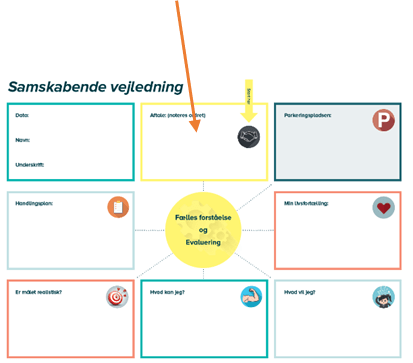
The model consists of eight elements:Agreements
- Parking space
- My life story
- What do I want?
- What can I do?
- Is the goal realistic?
- Action plan
- A formative evaluation element called: shared understanding and evaluation
Using the model
The model should be placed on the table between the counsellor and the counselee. Both participants will then continuously fill in the model. An object (a small car, a stone etc.) is placed by the element currently in focus.
Apart from the agreement element, which has to be the starting point, the elements can be accessed in the order you agree on. You do not need to visit all elements if you do not think it necessary to work on all of them.
The formative evaluation element is an element you visit every time you have worked on one of the other elements. This is where you have a meta conversation about the counselling. What is important next? Is the counselled comfortable with the way the counselling has been/is being implemented?
Evaluating the model
In the project, we saw that the relationship between the counsellor and the counselled was perceived to be very important. Furthermore, the interviews revealed that three elements in particular mattered in building the relationship in a career guidance interview:
- The process
- The counsellor’s recognition of the counselee
- The counsellor’s way of behaving
Using a process model where the involvement of the counselee is taken seriously, help build an important relationship between the two parts.
Evaluations from trials gave really good feedback.
It was great to have the model be visible throughout the conversation. I was also told that I should help fill the model out with the counsellor. I had never tried that before. It became very clear.
Counsellee
I felt that I got a really good overview of everything we need to work on in the future. I’ve been given a copy of the sheet and need to look at it often.
Counsellee
This guide interview was distinguished by the fact that we had the model as the starting point for the conversation and as a product that we had to create and complete together. We already had a mutual starting point for the guidance to succeed. Even from the beginning, the counselee took responsibility for the process.
Counsellor
Links to social justice
The new process model can also help the counsellor to support social justice. I am here inspired by Hooley, Sultan and Thomsen’s five signposts to a socially just career guidance.
- conscientisation;
- the naming of oppression;
- problematising norms, assumptions and power relations;
- building solidarity and collective action;
- working at a range of levels and scales from the individual to the global.
The five elements can be used as a tool in the model element ‘My life story’, in the element ‘What do I want?’ and in the action plan. Some of the five elements can be included in many of the proposed methods that are given in relation to the model.
The idea behind using the critical approach is to work against individualisation and make the counselled aware of the context their problem is a part of. This may give new ideas on how to work with the problems, and the counselee’s experience of guilt is minimised.
 Critical Perspectives on Career and Career Guidance (COCAG)